

TOO GODDAMN BAD.
A Conversation with the Founder of Rational Emotive Behavior Therapy--Dr. Albert Ellis.

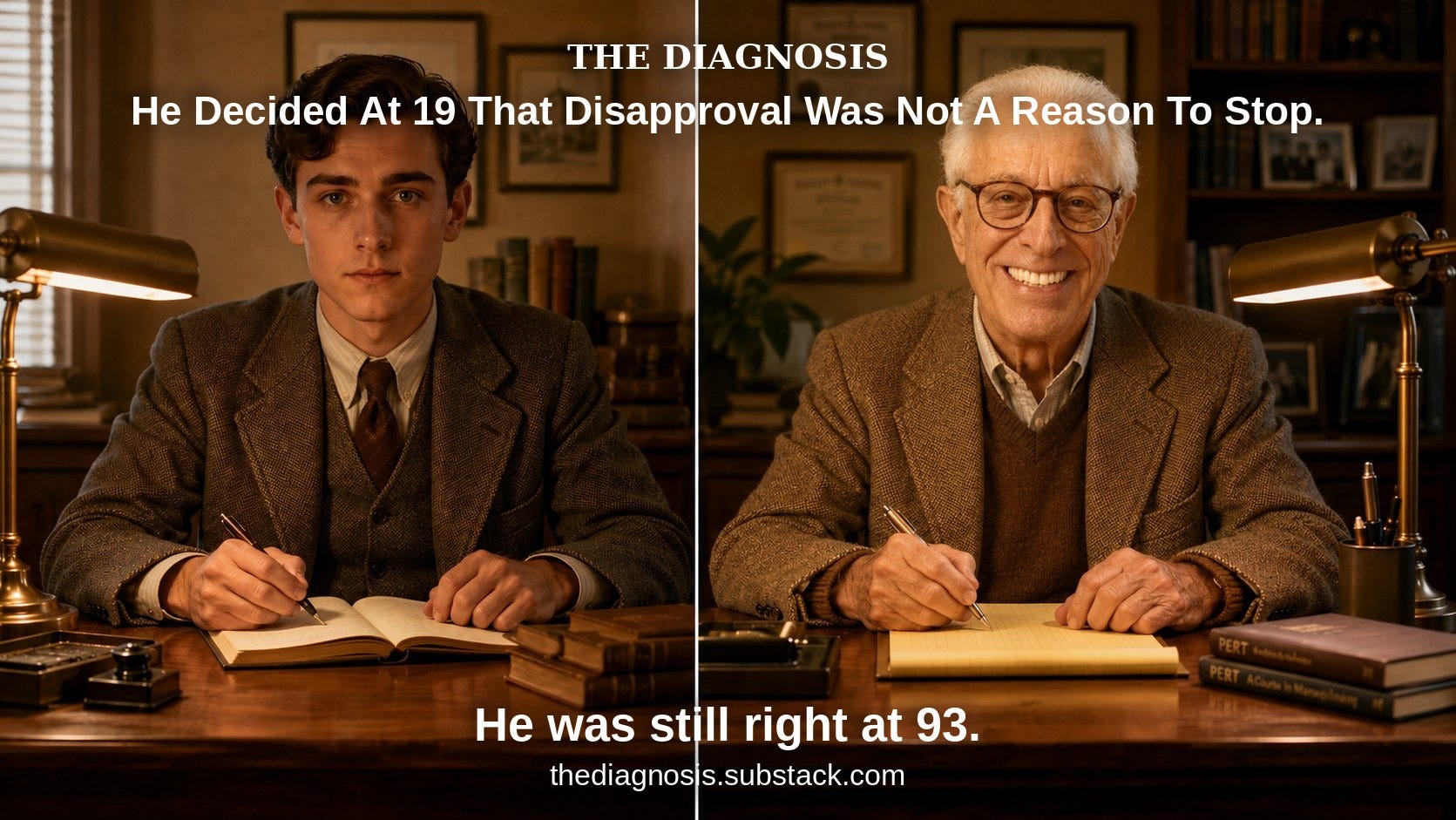
Interviewed by Ross Grossman, MA, LMFT
This is THE COUCH — archival conversations with the people who built modern psychology, recorded 1995–96 and published here for the first time.
Albert Ellis (1913–2007) founded Rational Emotive Behavior Therapy in January 1955 — the first of the major cognitive behavioral therapies and the direct ancestor of CBT, DBT, ACT, and most evidence-based practice that followed. He wrote more than eighty books, trained thousands of therapists at the Albert Ellis Institute in New York, and ran individual and group therapy sessions until weeks before his death at 93. In a 1982 survey, American and Canadian psychologists ranked him the second most influential psychologist in history — ahead of Freud. In 2013, he was posthumously awarded the APA’s highest honor: the Award for Outstanding Lifetime Contributions to Psychology.
In 2005, at 92, the board of the institute he founded voted to remove him without notice, citing his medical expenses. A New York Supreme Court judge reinstated him, calling the board’s actions “disingenuous” and “contrary to fair play and the spirit of the law.” During the legal dispute Ellis kept his key to the building, let himself in on Friday nights, and continued his weekly public workshops. He had been running them for forty years. He did not consider stopping.
His central argument — that human beings disturb themselves through irrational demands they mistake for legitimate needs — has never seriously been refuted. It has been rebranded many times. This interview was conducted in 1995, when Ellis was 82. This interview has been edited for length and clarity.
In 1995 — two years into my licensed clinical practice — I had a theory about Albert Ellis. The theory was that he was probably difficult to be around, almost certainly right about the important things, and possibly the most underappreciated figure in the history of American psychology. After ninety minutes with him I revised the theory slightly. He wasn’t underappreciated. He was actively resisted — stopped mid-lecture at a psychiatric center in Nebraska, banned in California counties, dismissed by a field that spent thirty years catching up to what he’d already published.
He wasn’t bitter about it. That surprised me.
I came to Ellis through David Burns. Burns had given me the vocabulary for distorted thinking — the cognitive errors, the thought records, the systematic corrections. It was useful. It was also, I eventually realized, incomplete. Burns was asking: is this thought accurate? Ellis was asking something harder: what if it’s true?
What if the catastrophe actually happens? What if the worst thing you can imagine is exactly what occurs? Why can’t you stand it? Why is it unacceptable? Prove it.
That question changed how I practiced. It also changed how I lived. Ellis didn’t help you feel better about things you might be exaggerating. He walked straight into the exaggeration, called its bluff, and showed you that your terror of the boogeyman was the problem — not the boogeyman. The catastrophe was survivable. The certainty that it wasn’t was the thing making you sick.
I was smitten by this. If anyone can be smitten by a psychotherapy theory I was smitten by REBT. I still am.
Ellis built something that actually worked. Not “worked in the context of the therapeutic relationship” or “worked for highly motivated clients in controlled settings.” Worked. He had the studies. He had the outcome data. He had patients who got better and stayed better — not patients who felt better for a few sessions and then called him back. The field responded to this the way fields usually respond to people who are correct ahead of schedule: it ignored him, then absorbed him, then forgot to give him credit.
I interviewed him for a book that never happened. This is the conversation, thirty years later. He was 82 when we sat down. He had already outlived most of his critics. He was still running four therapy groups a week, still writing, still using language in public that would have gotten anyone else removed from a convention in 1950. He used it anyway. He had decided at 19 that other people’s disapproval was not a legitimate reason to shut up.
He was right about that too.
The interview begins with his mentors. It ends with his view of death. In between, he names names.
THE PHILOSOPHERS
You really are the founder, the grandfather, of cognitive behavior therapy. Can you say, Dr. Ellis, who your mentors were in your path as a therapist?
ELLIS: The main ones were philosophers. The Asians to some degree but more specifically Epictetus¹, Marcus Aurelius², Bertrand Russell³, Emmanuel Kant, John Dewey⁴. The main ones were philosophers rather than psychologists. I got things from the psychologists too but basic theory came from philosophy.
You’ve written so many books on this issue — but could you say, how do people change?
ELLIS: People change mainly by acknowledging very clearly that they are a large part of their disturbance. They don’t just get disturbed. They get disturbed within a framework, a social framework and the experiential framework. They’re in society but they mainly upset themselves when they’re neurotic. Not just severe personality disorders and psychotics. Neurotics mainly upset themselves by changing their desires, goals and preferences (which they both learn and are biological) into rigid shoulds, oughts and musts. If they see this and work very hard cognitively and emotionally and behaviorally they can change themselves.
And they will never totally get rid of their shoulds and musts because you were saying there’s some biological basis to it.
ELLIS: Not only that but somehow they have to distinguish it. They better distinguish between conditional shoulds — ‘If I want a degree I have to pay my dues and go to school and pass my subjects’ — which is okay, and absolute shoulds and musts: ‘No matter what I do they should give me my degree.’
You are not a believer in a lot of personal history work.
ELLIS: No, you can review very quickly their history, largely to decide how biologically disturbed they are, what their inherited tendencies toward disturbance are. You can sometimes show them that when they were disturbed as children they then told themselves a very disturbing philosophy. That explains it better. But you can also do that with relatively little of the past, sticking mainly to the present.
Some therapists believe that one must work emotionally and one must work on letting out the feelings. This is not a big part of RET.
ELLIS: No, I particularly show in my book on Anger — How to Live With and Without It — that if you let out your feelings you frequently exacerbate your disturbed feelings especially anger.
Some people also believe that we need to do grief work. I assume that your take on that is different.
ELLIS: Well we consider grief, real grief, or genuine grief as not an emotional problem. If somebody dies who you love or even if you lose a very good job you’d better feel very sad and disappointed for a while — not forever but for a while. It would be good to experience that. So if you came with that problem we’d say “well, why is that a disturbance?”
Now if grief turns to depression, which it frequently does — which is almost light years away from grief — then it really means that this very sad thing should not, must not, have occurred. We’d show the person how to get in touch with the grief and depression but change the depressogenic⁵ ideas.
FEEL BETTER OR GET BETTER
Do you see any modalities in psychotherapy dominating in the future?
ELLIS: Unquestionably, in my prejudiced view, cognitive and cognitive behavior therapy, Rational Emotive Behavior therapy and its various allied therapies.
And you see this happening because of the efficacy of the therapy or because of the HMOs?
ELLIS: No, no, largely because it’s been shown to be more efficacious in clinical work and in many studies. The other kinds of therapies have rarely been shown to be efficacious and also they make people — like Gestalt therapy or psychoanalysis — feel better but not get better. They do not make what I call a profound philosophical change.
So there’s a way to do cognitive therapy shallowly and a way to do it deeply.
ELLIS: Shallowly would be mainly to do just what we call the Automatic Thoughts or the Light Irrational Ideas. Deeply would be the concept that whenever you neurotically disturb yourself — ‘look for the should, look for the must, find it, rip it up, act against it and feel against it.’
Do you see any patterns that have been occurring over the history of psychotherapy?
ELLIS: There are many fads and patterns over the history. Actually originally therapy — as with the ancients and with early therapy in the 1900s — was largely cognitive. But then because of Freudianism it became exploration of the past and we could call it largely expressive and emotive. Gestalt therapy came along and experiential therapy which in a different way were expressive and emotive. Then behavior therapy came along in the early part of this century and especially after 1950 and showed a great deal of help to people, especially mentally deficient people, and other kinds of handicapped people.
Then I started in 1955 the first of the major cognitive behavior therapies and now even the cognitive behavior therapies have had fads such as constructivism which tends to ally it with a lot of psychoanalytic exploration and existential searching for philosophies rather than try to get people to change. So there are continual fads in psychotherapy and some of them add to it and others detract from effective therapy.
Have you been called a constructivist, Dr. Ellis?
ELLIS: I wrote a paper in 1990 — my book The Essential Albert Ellis — showing that REBT is really a pioneering and main constructivism, more constructive than the so-called constructivists, because we believe that people construct their demands, commands, shoulds, oughts and musts. They don’t merely learn them from their parents and culture as many other cognitive behavior therapists would tend to believe. They construct them and they have the power practically always of deconstructing them or reconstructing them.
So in many ways Epictetus was a constructivist. So was George Kelly⁶ who wrote a book in 1955, The Psychology Of Personal Constructs, but I didn’t read it until several years after I had formulated REBT. We are clearly in the constructivist tradition at least in theory but we’re much more active directive than some of the constructivists.
If somebody does REBT on a regular basis and really attacks their shoulds, oughts, musts, have to’s, awfulizing⁷ — will that person get down to an underlying truth or will they need to construct a new reality for themselves?
ELLIS: Well not a truth because there is none. No such thing probably is true with a capital T. They’ll get down to what we would hypothesize as a very effective philosophy and become less disturbable. Not less disturbed. REBT has always gone for less disturbable but now more so than ever.
THE FADS
What mistakes are therapists making right now?
ELLIS: Well there are many of them. The Rogerian therapists give unconditional positive regard or unconditional acceptance. They think that by modeling it you will get it. Actually if I give you unconditional acceptance when you do something stupid and wrong then you’re very likely to say I’m okay because Dr. Ellis likes me and approved me — now that’s really conditional. So the Rogerians are mostly giving conditionally and falsely saying that it’s unconditional. If you go out into the world and do the same thing then everybody else will hate you and then you’ll tend to hate yourself again.
Psychoanalysts make the huge mistake of thinking that if you understood exactly what happened in your past that will change you. But actually if you understood what ideas you had in your past and how to remove them then that would help you. But the mere insight alone, even REBT insight, doesn’t help you that much.
Insight number One: you may upset yourself when you’re neurotic. Two: no matter how long you’ve been doing that you’re still doing it. You still have a nutty philosophy. But insight number Three is that there’s no way but work and practice. Most of the Gestalt and experiential therapies think that if you let feelings out they go away and stay away. Actually they would go away temporarily or even increase anger.
So there are innumerable mistakes in psychotherapy. Some of them do partly good. They help you feel better but they sidetrack you from getting better. Much of psychotherapy today is various diversion techniques where they have you relax or do biofeedback — instead of doing these techniques first and then still changing your basic attitude after.
There are forms of therapy based on the idea of affirmations, saying positive things to yourself, doing self-hypnosis.
ELLIS: An affirmation is a new name for positive thinking; Émile Coué⁸ discovered it after Bernheim⁹ in 1871. [Editor’s note: Bernheim’s foundational work on suggestion was published in 1884, not 1871.] Bernheim discovered that hypnosis was largely suggestion. It wasn’t mesmerism or magic. Coué correctly added to Bernheim that it was self-suggestion or auto-suggestion. So he invented auto-suggestive techniques, especially his famous slogan “Day by day and every way I’m getting better and better.”
Positive suggestion will help you do better and feel better. Unfortunately ‘day by day and every way I’m getting better and better’ is too optimistic and too utopian. Pollyannaish. So Coué went out of business.
The corrective positive thinking — “I can hit the tennis ball better” — is okay if it’s not too Pollyannaish. But it covers up very frequently the thought ‘but suppose I don’t, suppose I can’t?’ Therefore positive thinking by itself frequently only works temporarily or doesn’t work at all.
Positive thinking has its usefulness if properly used but it has its exaggerations. It had better be combined with first disputing your irrational self-defeating belief and then doing positive philosophic things. If you say ‘I can succeed, I can succeed’ that’s nice and may help you succeed but it would be better to say ‘I can succeed and if I don’t, too damn bad. I can still accept myself as a valuable human to myself even when I don’t succeed.’ You see that’s a philosophy.
You and Beck and Burns differ on the matter of which thoughts to analyze. You appear to favor imagining the worst case scenario and seeing yourself as being okay despite things not turning out.
ELLIS: We’re much more likely to use that than they are. That’s one of our favorite techniques. They may throw it in; but to get the elegant result you’d better often imagine the worst thing happening or even risk the worst thing happening at times. For example, failing a very good job performance or job interview. Imagining this will show you something — you never have to seriously upset yourself, even at that. So we would use that much more than Aaron Beck and his followers.
The strategic therapist’s idea is to end symptoms.
ELLIS: Yeah, that’s right. The solution focused therapists who are very popular these days. The HMOs accept them. They say ‘now that you’re depressed what did you do last time to get over it?’ They show you that you may have got over it but you may have done the wrong thing or the temporary thing.
How does someone know they’re seeing the right therapist?
ELLIS: There’s no absolute way, you just have to pick a therapist that you think is on the right track, has a decent theory and practice and then get along with that therapist and do well. But there’s no absolute way because there’s no Right with a capital R. You could prove that it’s helpful maybe but it could be more helpful to do something else.
Do you see technology — computers — affecting therapy or fitting into therapy in our future?
ELLIS: My concept of the future of psychotherapy will largely be preventive more than curative, and will be taught in the school system from nursery school onward, mainly by use of computers.
Do you see it as a REBT computer program that someone talks to?
ELLIS: Well, first of all they could learn all the concepts by computer. The theory could be learned and then actually you could have computer programs with various offshoots and subheadings under them so that if they started with one problem it leads to another. Actually there are several programs already written using REBT on the computer curatively.
So you think it will be down to the elementary level — elementary school?
ELLIS: Yes I think it better be started practically in nursery school but on the computer certainly in elementary school.
(He said this in 1995. About computers. To a therapist with four kids and a fax machine.) —RG
Do you see children under the age of 9 or 10 able to capture the concepts?
ELLIS: Right. Yes they’re not that good unless they’re very bright at disputing irrational beliefs but if you work out with them the answer E — the Effective new philosophy or rational coping statements — and go over them, show them how to practice, practice, practice these statements, then they definitely can learn some of the main principles of REBT and use them on themselves.
Some people believe that meditation itself helps you to detach from the thinking process which would normally get you upset.
ELLIS: It does in different ways. One is, as I said, if you really meditate on ‘Om, om, om, om, om…’ or watch your thinking, just watch it, then at that time you can’t be awfulizing. So it’s a very good distraction technique and especially for some severely disturbed people (such as some of the people who originated some of the meditative techniques probably were, and they found out it works), then it can calm them down and distract them.
Now some meditative groups, a few of the Buddhist groups, have the philosophy of giving up ego. It sort of goes with it; it’s not Transcendental Meditation (which I don’t think has that philosophy) but some meditative groups really show you not to cling to ego and they’re not as specific as we are. We teach you to have ego. You have a self. You like to do better and win people’s approval but we show you how never to rate, measure, evaluate yourself. Just evaluate your thoughts, feelings and behaviors. So some meditative procedures get close to that but I don’t think they’re that specific.
THE CONTROVERSIES
In Reason and Emotion In Psychotherapy you write that you can work with schizophrenic individuals, with psychopathic or antisocial individuals. Are there any people who don’t belong in REBT?
ELLIS: Well there are people who don’t belong in any kind of therapy. Who won’t allow it or are so severely disturbed that without medication they won’t get much help. Even the severe personality disorders — which are very widespread, probably at least 30% of Americans including several ex-presidents — are partly or largely biological as well as self-inflicted. REBT is almost the only kind of therapy that helps them but it helps them to a limit, to degrees. They better be on medication along with the therapy. Manic depressives, without their lithium, will be off the wall and you’ll get nowhere with them.
(Epidemiological argument, not individual diagnosis. Ellis believed severe personality disorders were massively underdiagnosed — including in people running countries.) —RG
Do you agree with the idea that there is such a thing as a narcissistic personality disorder, a borderline personality disorder? Do you believe these conditions can be treated?
ELLIS: They usually always have A: cognitive thinking deficits and B: emotional deficits — under-reactivity or over-reactivity and C: behavioral deficits. They have ADD and all kinds of deficits. And then they have cognitive distortions — irrational ideas about the deficits. Then they’re put upon by most people for being deficient, because they really are deficient in many respects, and they have disturbances about that. So they’re seriously disturbed and even when I help them considerably they are hardly cured and they still could use lots of therapy, lots of readings. Most of them practically never get completely cured.
There’s been a lot of talk about recovered memory vs. false memory with sexual abuse. What’s your opinion?
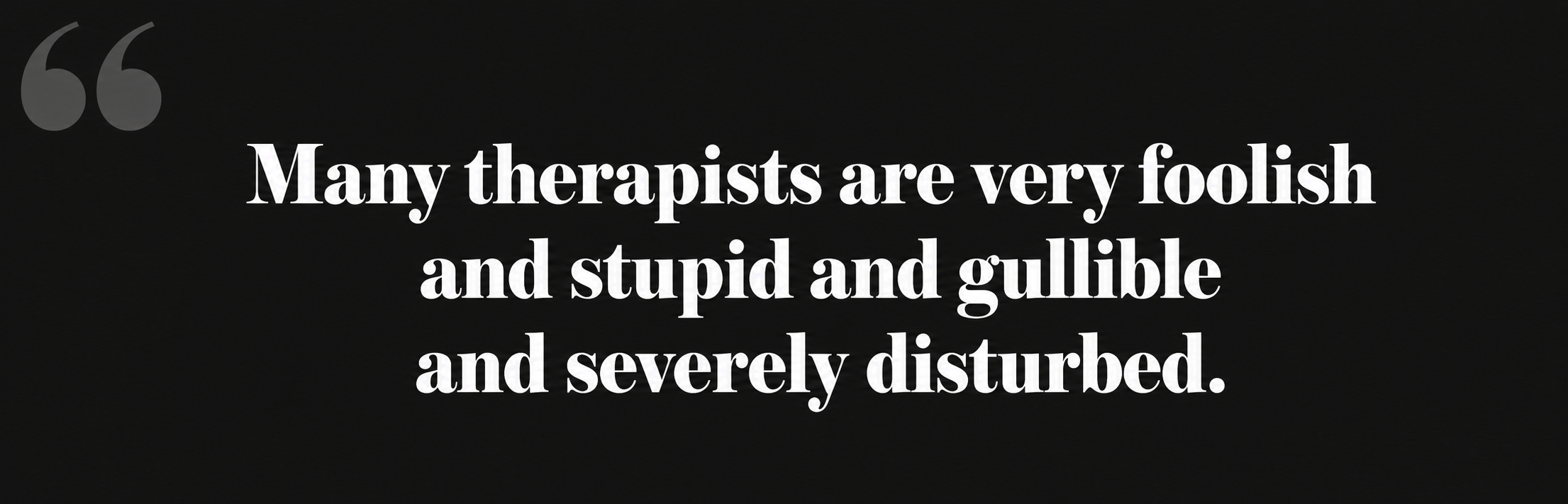
ELLIS: I believe that many therapists are very foolish and stupid and gullible and severely disturbed — so there are a lot of false memories created by therapists, largely psychoanalytic therapists and the new-age kind of therapists. The ones who Wendy Kaminer¹⁰ describes in her books.
You mean I’m Dysfunctional, You’re Dysfunctional*?*
ELLIS: Yes. These therapists create false memories and talk people into them. Now that doesn’t mean that nobody had incest and nobody got raped at an early age but there is a great deal of misleading stuff especially by analytically- and psychodynamically-oriented therapists.
And if a patient comes to you and says ‘Dr. Ellis, I’ve just remembered these things happened to me’?
ELLIS: First of all I’d wonder whether it really did happen so I’d probe to find out; did it only happen after they read one of those books that says that practically everybody with disturbance had incest with their father or mother or brother or sister when they were young? They may have been persuaded by reading or other materials to do it. And then even if it occurred I’d say ‘Now, let’s figure out A: what you were telling yourself then when this very bad thing occurred and B: what you’re still telling yourself about it now.’
There are several therapies that have come up in recent years that have been fairly controversial. I’m thinking in particular of EMDR¹¹ and also Neuro Linguistic Programming¹².
ELLIS: Well first Neuro Linguistic Programming has some very good cognitive-behavioral methods in it but the basic theory has been exploded several times. That is, if you’re a ‘hearing person’ then the therapist or sales person has to say ‘I hear you’ while if you’re a ‘seeing person’ they have to say ‘I see what you mean.’ Now that’s been exploded. That’s false. But they’ve taken some good points from REBT, cognitive behavior therapy and other therapies. Some of the things they do are good but they’re not to be trusted since they give certificates to housewives, to almost anybody who passes their so-called training courses. Just like other groups do — Avatar¹³ and things like that. Consequently, they have some very questionable practitioners. Now they have some good practitioners who are reputable — psychologists and social workers who use parts of it and do it quite well.
As far as EMDR — EMDR is a cognitive behavior therapy which has some very, very good points in it but which convinces people that their eye movements are crucial and has a sort of hypnotic effect. It’s questionable whether the eye movement is really that crucial or whether it really works or it works because you think it works. It has some studies of its effectiveness and it still is controversial. It can be used but it better be used by therapists who don’t buy it hook, line and sinker. If they do them during the cognitive behavior therapy they will definitely get better.
What are your perceptions of the popular therapists these days?
ELLIS: Bradshaw¹⁴ I think is a dogmatist, and does in all probability a lot more harm than good and helps people be babies for the rest of their life. Now I’m not saying he has no good things in there. Most therapists throw in all kinds of things which they may not even give credit for including REBT.
Are you referring mostly to his inner child work?
ELLIS: The inner child. You have inner thoughts but again he implies that you got them because of what happened to you as a child rather than your propensity to tell yourself certain disturbing things and to continue them. You have inner thoughts — this comes from REBT, Epictetus, Marcus Aurelius, etc. Bradshaw calls it your inner child and he really thinks if you whine and scream and get in touch with that inner child you’ll get better. He has some utter nonsense in there and some very harmful things mixed in maybe with a few good things.
(Ellis located the problem in what you keep telling yourself. Bradshaw located it in what was done to you. One of them had to be wrong.) —RG
Any other concerns?
ELLIS: Patrick Carnes¹⁵, I think, has put many — too many — people in the serious sexually obsessive class. Now there are OCD obsessive-compulsive disordered people who have a real disturbance and one of the severe personality disorders. When they attach it to sex, which they sometimes do, not that often, then they are compulsively promiscuous and do all kinds of self-defeating things. So they’re seriously disturbed and I wouldn’t advise those self-help groups for them as much as I would advise a great deal of good rational-emotive behavior therapy.
But let’s not exaggerate and think that any promiscuous person is compulsively so. Some just would like to be promiscuous and think promiscuous thoughts but don’t get into any trouble. Patrick Carnes and his group — Sex Addicts Anonymous — would convince many people that they’re seriously disturbed when they’re not.
I have a case in my book on brief therapy of somebody who’s the author of several popular books. In Los Angeles where I gave a public workshop he came to me as a sort of sex addict and I showed him in 10 or 15 minutes that he really did not have an addiction and he got cured. But his therapist and other books that he was reading were telling him different.
So Patrick Carnes may help some of the people some of the time but I think he induces people to think they’re obsessive-compulsive about sex when they really aren’t.
This is Ellis’s stated clinical opinion, not a formal finding. The broader debate he’s pointing at is real: hypersexual disorder was proposed for DSM-5 in 2010 and declined for inclusion — a decision that partially aligned with Ellis’s skepticism about the diagnostic category. Carnes’s model has both defenders and critics in the clinical literature. Ellis, characteristically, had no interest in the middle ground. —RG
What’s on the other side:
Ellis on sex, marriage, and whether humans are actually monogamous.
His view on antidepressants — and whether good therapy makes them unnecessary.
What he said about death that I’ve been thinking about since 1995.
His lowest professional moment. The lecture they stopped mid-sentence.
And the two things he practiced every day from 19 to 93.
If you’ve read this far, you already know whether you want the rest.
This is the first of twenty conversations I recorded in 1995 with the people who built modern psychology. Never published until now. $79/year through June 30th.
